
Evidence Map on Graduation Programmes
Welcome to the Evidence Map—a comprehensive resource designed for policymakers, practitioners, researchers, and anyone interested in understanding the impact of the Graduation approach for poverty alleviation.
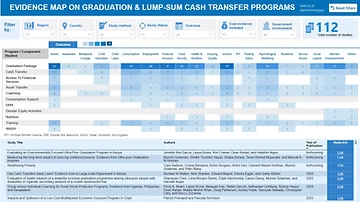
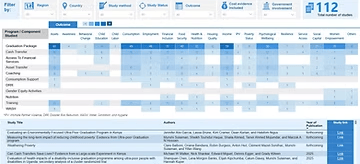
This interactive map organises more than 100 studies on Graduation programmes, their component parts, and some lump-sum cash transfer programmes, from Asia, Africa, and the Americas, making it easy to discover what works, where, and for whom. The evidence map presents a clear matrix of programme components (e.g., asset transfers, cash grants, training, and coaching) and the outcomes they affect (e.g., income, food security, health, education, and more). For further details on how the map has been developed and its contents, including definitions of interventions/components studied and outcomes, please see the brief narrative report.
What can you do here?
Browse the evidence: Quickly find studies by intervention type and outcome.
Support decision-making: Use the map to inform evidence-based strategies for scaling up effective poverty reduction initiatives.
Identify gaps: See where more research is needed to inform future programs and policies.
Start exploring to unlock insights that can help shape the future of poverty alleviation. If you know of any studies that might be included in the map, let us know by contacting: anindita.bhattacharjee@bracu.ac.bd.
How to Navigate the Evidence Map
Filter and Search: Use built-in filters to narrow results by region, country, study method, and more. The total number of studies available for the selected filter(s) is displayed in the upper-right corner of the dashboard, and the list of studies is shown at the bottom. Use the ‘Reset filters’ button at the top-right corner to reset all selected filters.
View Study Counts: Each cell shows how many studies have examined the effect of a specific intervention/component on a particular outcome.
Explore by Programme Component/Outcome: Use the rows to select different types of interventions/components studied, or the columns to select different outcomes, and view the list of studies for selected components/outcomes at the bottom.
Access Study Details: Click a cell to view the list of corresponding studies at the bottom, including author details, publication year, and links to full reports, where available.
Identify Evidence Gaps: Look for areas with few or no studies—these highlight where more research is needed.
To access the Evidence Map click on the below button


Online map citation:
Bhattacharjee, A. (2026) Evidence Map on Graduation Programmes. [Online map]